 Posted by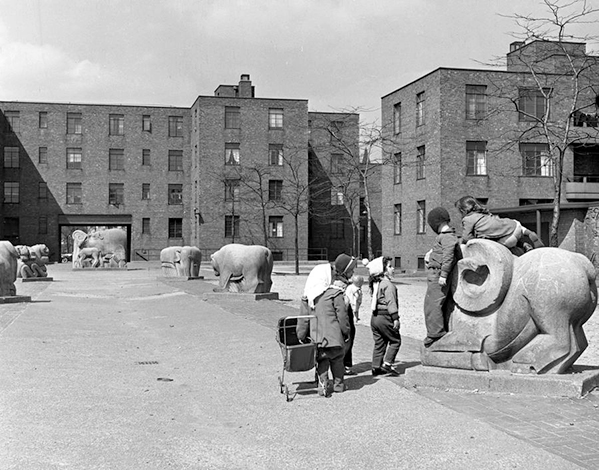
Join Dr. Chris Stacey for a discussion about the early years of public housing in Chicago. In 1937, the Chicago Housing Authority (CHA) was established as a state-charted institution. The CHA was a municipal not-for-profit corporation, governed by commissioners who were appointed by the Mayor of Chicago. The CHA was initially governed and run by Progressive housing reformers who sought to use public housing to rescue poor families from slum conditions. This is a tale about how the CHA was deeply influenced by federal guidelines on site selection, tenant selection, and the cost of building housing projects, which ultimately determined the course of public housing in Chicago throughout the 20th Century.
The PWA, a federal agency, selected the sites for the CHA's first four housing projects and provided the financing to build the Jane Addams Homes, the Julia C. Lathrop Homes, the Trumbull Park Homes, and the Ida B. Wells Homes. The CHA took over management of these four pre-war housing projects once they were built. All four of the Chicago’s pre-war housing projects were segregated to an extreme degree due to the implementation of a federal policy called the “neighborhood composition rule.”
As a consequence, the controversy over the site selection process for the CHA's next two proposed housing projects - the Francis Cabrini Homes and the Robert Brooks Homes - led the CHA to never again propose a large-scale slum clearance and housing project in a white neighborhood after 1939. In the aftermath, almost every housing project the agency built in the 20th century was sited in African American neighborhoods.
New Date: Wednesday, December 16, 2026
Times: 6:00PM Central, 7:00PM Eastern, 4:00PM Pacific. For those in Europe the time is 12:00AM in London on December 17.
Location: Zoom Video Conference
Photo Credit: "Jane Addams Homes," Chicago Gang Project, Public Domain